
Views: 0 Author: Site Editor Publish Time: 2026-08-26 Origin: Site


Sourcing gifts for corporate events or weddings requires absolute precision. Mismatched accessories routinely cause poor presentation, transit damage, or incompatible bottle fits. Purchasing generic items without checking technical specifications is a common mistake in retail planning. While manufacturers frequently market their stoppers as "universal," this claim rarely holds true in reality. Variations in glass bottle bores and gift box depths demand exact dimension matching before you ever place a bulk order. Overlooking these constraints risks damaging the retail packaging or failing to seal the wine properly.
We provide an objective framework to help evaluate material requirements, design measurements, and packaging compatibility. You will learn the precise industry standards for standard 750ml wine bottles. We also outline essential testing protocols to ensure your next bulk order is a complete success. By following these guidelines, you can seamlessly integrate elegant accessories into your product lineups without logistical headaches.
Many suppliers sell products under the label of a "universal fit." You should treat this marketing term with caution. A single size cannot perfectly seal every type of bottle on the market. Different wine styles use distinct glass molds. For example, traditional corked bottles have varying internal neck profiles. Screw-cap bottles feature different lip structures. You must understand these variations to choose a functional product.
Industry standards provide a reliable starting point. The average internal opening of a corked 750ml wine bottle measures between 18mm and 19.5mm. To secure an airtight seal across this range, the plug base requires a specific taper. The optimal shape starts at approximately 15mm at the bottom tip. It then widens to 20mm or more near the top. This conical shape ensures the plug wedges tightly into the glass neck. Knowing the exact wine bottle stopper diameter guarantees you purchase items capable of preserving the beverage properly.
The base material heavily impacts this fitting process. Different materials react uniquely to pressure inside the bottle neck. We evaluate three common base options below:
| Material Type | Compressibility | Seal Reliability | Best Application |
|---|---|---|---|
| Silicone / Rubber | High | Excellent | Reusable retail accessories |
| Natural Cork | Medium | Moderate | Short-term decorative events |
| Solid Metal (with O-rings) | Low (relies on O-rings) | Good | Premium corporate gifting |
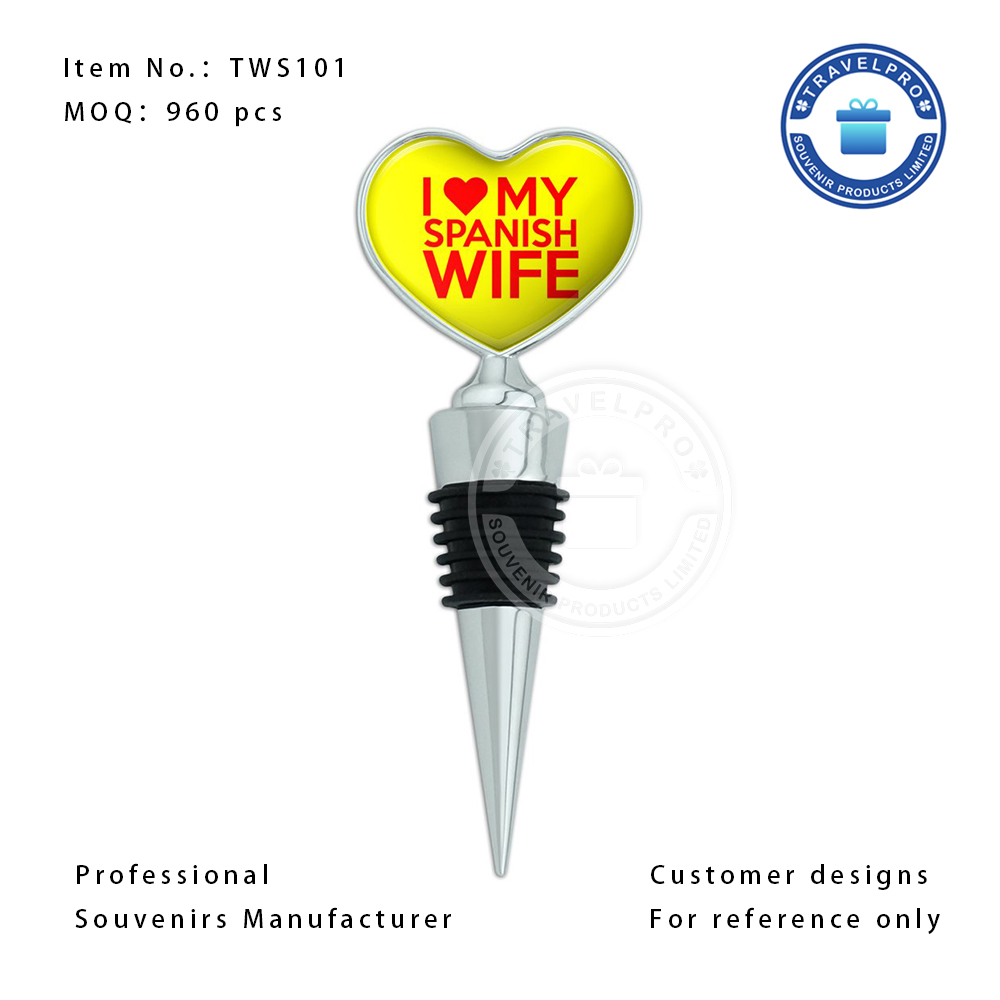
Designing a memorable gift requires balancing aesthetics with physical constraints. You must divide the product into two distinct measurement zones. The first is the functional plug length. The second is the decorative top, commonly known as the finial. Balancing these sections helps you determine the ideal souvenir wine stopper size for your specific project.
A standard functional plug length ranges from 1.5 to 2 inches. This length provides enough surface area to grip the bottle neck securely. The decorative finial usually adds another 1 to 2.5 inches. Therefore, the total recommended length for standard retail presentation boxes falls between 3.5 and 4.5 inches. Going beyond these limits frequently causes packaging failures.
Gift box depth presents a rigid constraint. Standard retail packaging typically features an internal clearance of 1.5 to 2 inches deep. If your product exceeds this thickness, you risk "lid bulge." A bulging lid ruins the presentation and exposes the item to damage. You must measure the thickest part of the finial. Compare this measurement directly against the internal dimensions of your chosen box.
Center of gravity also plays a crucial role in packaging design. Top-heavy designs pose unique challenges during transit. A heavy decorative top easily dislodges from shallow inserts. To prevent this, you require deeper insertion into the box's foam base. The foam must grip the heavy upper section tightly. We recommend recessing top-heavy designs at least halfway into the protective insert.
Material selection drives the perceived value of your gift. It also dictates your shipping strategy and packaging budget. Each material behaves differently during transit. You must align your material choice with your target audience and logistical capabilities.
Many corporate clients prefer a custom metal stopper made from zinc alloy or stainless steel. These metals offer distinct advantages and disadvantages.
Glass and crystal toppers remain a traditional favorite for wedding souvenirs. They offer a highly premium aesthetic. Light catches the facets beautifully. However, glass is incredibly fragile. You cannot pack glass items in low-clearance boxes. They require shock-absorbing materials like silk linings or custom-molded high-density foam. A sudden drop easily shatters the finial if the packaging lacks proper cushioning.
Wood and resin designs offer modern alternatives. These materials lower your shipping costs significantly because they are lightweight. They place far less strain on standard gift set inserts. You can safely use cardboard cutouts for wood products. The primary drawback involves manufacturing tolerances. Wood and resin are subject to dimensional variations. You might see slight size differences from batch to batch. Always communicate acceptable tolerance limits to your manufacturer.
A premium accessory loses its appeal if it arrives rattling around inside a cheap box. The interior insert acts as the foundation of your presentation. You must match the insert material to the weight and dimensions of your product. Selecting the right insert ensures your wine gift accessory survives global shipping networks.
We classify box inserts into three main categories. You must respect the dimensional tolerances of each type:
Multi-item gift sets introduce additional spacing requirements. You might pair a stopper with a corkscrew, a pourer, or a foil cutter. Never place metal accessories too close together. You must leave a minimum 0.5-inch buffer between individual components. This buffer prevents the items from knocking together and scratching their polished finishes. Properly spaced layouts also look much more professional upon opening.
| Insert Type | Ideal Product Weight | Required Dimensional Tolerance | Risk Factor |
|---|---|---|---|
| Die-Cut EVA Foam | Heavy (Metal/Alloy) | +/- 1mm | Low (Highly secure) |
| Flocked Blister Plastic | Medium (Resin/Glass) | +/- 2mm | High (Prone to cracking) |
| Cardboard Cutout | Light (Wood/Silicone) | +/- 3mm | Medium (Prone to tearing) |
Moving from the design phase to bulk production involves significant financial risk. A structured decision framework minimizes this risk. You must establish strict technical requirements before signing any purchase orders. Relying on vague descriptions leads directly to inventory disasters.
First, mandate technical specifications from your supplier. Always request a formal tech pack or a mechanical drawing. The drawing must detail the total length, the finial width, and the maximum gasket diameter. It should clearly define all souvenir stopper dimensions in millimeters. Do not accept rough estimates. Accurate drawings allow your packaging supplier to start cutting foam inserts immediately.
Second, enforce the prototype rule. Never order bulk packaging before testing a physical prototype inside the intended gift box. Digital renderings look perfect, but physical reality often reveals flaws. You need the physical item in your hands to verify the friction fit. Slide the prototype into the foam. Close the lid to check for bulging.
Finally, execute a rigorous testing protocol. Secure the item inside the box insert and perform a vigorous "shake test." If the item pops out, your insert design requires adjustment. Next, test the sealing capabilities. Try the plug on three different empty 750ml bottles. Use one standard Bordeaux style, one sloping Burgundy style, and one modern screw-cap bottle. A successful product will form a tight, leak-proof seal across all three variations.
A: The base of the stopper should taper from roughly 15mm up to 22mm to effectively seal standard 750ml bottles, which typically have an 18mm to 19.5mm opening.
A: No. Champagne and sparkling wine bottles have wider openings and require specific pressure-clasp stoppers to contain carbonation safely.
A: Most single-stopper gift boxes measure approximately 5" (L) x 2.5" (W) x 1.5" to 2" (D). Always verify the thickest part of your stopper design does not exceed the box depth.
A: Use high-density EVA foam inserts cut exactly to the stopper's silhouette, ensuring the heavy finial is fully supported and recessed below the lid line.

