
Views: 0 Author: Site Editor Publish Time: 2026-08-09 Origin: Site


The attachment is the critical failure point of any souvenir product. A premium enamel pin or beautiful acrylic charm loses all value the moment its hardware fails. The item feels cheaply made. We know wholesale buyers, souvenir shop managers, and custom creators face daily pressure. You must carefully evaluate hardware components before upcoming production runs. A broken souvenir ruins the customer experience quickly. It also damages your brand reputation long-term.
Selecting the right souvenir keychain attachments requires a highly strategic approach. You cannot simply pick the cheapest option available. We must balance unit cost, assembly time, aesthetic alignment, and long-term durability. This guide explores foundational ring styles, clasp upgrades, and structural connectors. You will learn how to match specific hardware to your materials. We will also help you source reliable components properly. You can maximize both your profit margins and retail quality.
You must evaluate cost-to-value ratios first. Retail pricing dictates your baseline hardware budget. A premium hardware upgrade eats into profit margins quickly. You cannot put a two-dollar swivel clasp on a simple three-dollar souvenir. Buyers must align the hardware cost with the final retail expectation. High-end museum gifts justify heavy brass hardware. Basic novelty items require cost-effective steel components.
We must track mechanical reliability closely. You should distinguish static hardware from dynamic hardware easily. Rings remain completely static. They rarely fail under normal everyday conditions. Spring-loaded clasps operate dynamically. They show much higher failure rates over time. Internal springs lose tension. You should balance these known mechanical risks carefully during procurement.
Consider assembly labor dynamics next. Pre-assembled chains save massive amounts of production time. Attaching charms manually demands intense labor hours. Factory assembly usually beats domestic manual labor costs. You must calculate the time required to close jump rings securely. Small production batches might absorb this manual labor. Massive commercial runs require fully pre-assembled hardware chains.
Environmental resilience also matters deeply. Where will tourists actually use these items? Beachside shops require highly corrosion-resistant components. Salty ocean air destroys cheap metal finishes fast. Indoor museum stores might accept basic zinc alloy safely. Always test your hardware against the target tourist environment. Proper plating prevents rust and customer complaints.
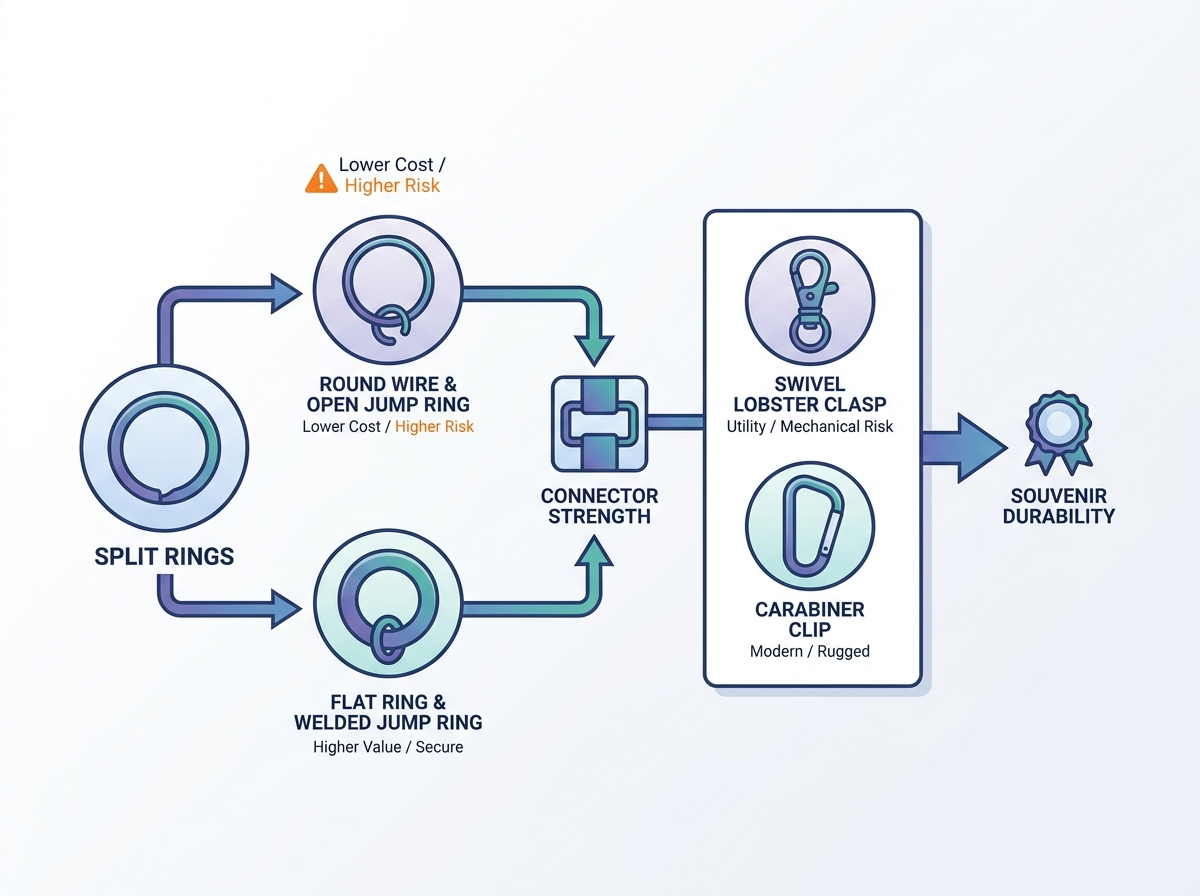
Standard round split rings provide a solid foundation. They dominate high-volume merchandise globally. You often see them paired alongside lightweight PVC charms. They keep production costs extremely low. However, serious implementation risks exist. Users might over-stretch them during key insertion. This action causes permanent wire deformation. The ring never closes tightly again. Keys slip out easily over time.
Flat split rings offer an excellent upgrade. We recommend them for mid-to-high tier merchandise. The wider surface area presents distinct visual advantages. It reflects light much better. It provides space for custom laser engraving. It also resists deformation far better than round wire. You can elevate perceived value easily. Choosing a sturdy keychain split ring protects your custom design. Customers appreciate the robust, premium feel.
Wire cable rings cross over into EDC territory. You see these often in rugged souvenirs. They boast high durability overall. They utilize aviation-grade aluminum or steel threads. Yet, they deviate from traditional retail aesthetics. Buyers must thread the barrel closure carefully. Poor quality control leads to stripped screw threads. We advise testing samples thoroughly. Evaluate them before placing major factory orders.
Premium clasps add distinct retail appeal. Upgrading your keychain clasp options justifies higher retail prices. Swivel lobster clasps remain incredibly popular. They suit quick-attach scenarios perfectly. Users clip them onto backpacks easily. The built-in 360-degree swivel prevents tangling efficiently. However, they carry hidden mechanical risks. Internal spring fatigue drives most consumer returns. We urge buyers to require strict tension testing.
D-Ring carabiners deliver a modern utilitarian aesthetic. They suit heavy metal souvenirs best. They withstand daily abuse remarkably well. The gate mechanism usually relies on a simple metal leaf spring. This particular design rarely fails. It offers a satisfying, secure click. Leather souvenir makers prefer D-Rings for their wide, flat base.
Push-gate clasps look sleek. They provide a seamless visual profile. Unfortunately, they lack true structural integrity. Use them strictly for lightweight decorative charms. Heavy key loads pop them open unexpectedly. The gate relies on outward pressure. A twisted key easily breaks this delicate tension mechanism.
Connectors bridge the main ring and your charm securely. Jump rings serve as the primary link. Open jump rings allow faster manual assembly. Yet, they represent the main structural failure point. Open rings bend easily under pocket pressure. Customers lose valuable charms frequently. We strongly recommend using welded rings instead. Thick-gauge triangular jump rings also work exceptionally well. Integrating reliable custom keychain hardware reduces breakages significantly.
Compare short link chains against figure-8 swivels. Chains offer great flexibility and appealing length. Unfortunately, individual chain links can snap under sudden tension. Figure-8 swivels present a robust alternative. They create direct, solid connections between parts. They also reduce daily entanglement risks efficiently. A solid swivel handles twisting forces perfectly.
String-based cords serve highly specific niches. Consumer forums often request these soft attachments. They cost very little to produce at scale. They completely eliminate metal scratching against delicate surfaces. However, they remain highly susceptible to edge fraying. Daily friction cuts through nylon cords eventually. You must warn buyers about this shortened lifespan.
| Connector Style | Assembly Speed | Structural Durability | Ideal Use Case |
|---|---|---|---|
| Open Jump Ring | Very Fast | Low | Budget, lightweight items |
| Welded Jump Ring | Slow | High | Commercial retail runs |
| Figure-8 Swivel | Moderate | High | Tangle-prone bag designs |
| Lanyard Cord | Fast | Medium | Scratch-sensitive acrylics |
You must actively match hardware components to your specific materials. Mismatched components ruin the overall product presentation. A delicate charm requires delicate hardware. A heavy charm requires industrial-strength connectors. Follow these material guidelines closely.
Material harmony creates a premium feel. Buyers notice when a heavy clasp drags down a light charm. They notice when cheap wire holds a beautiful enamel pin. Focus on the physical balance during the design phase. Test a physical prototype before ordering thousands of units.
Sourcing raw materials dictates your final profitability. Selecting bulk wholesale keychain parts means evaluating base metals carefully. Iron boasts high physical strength. Sadly, it rusts quickly if the surface plating chips. Zinc alloy dominates molded clasp manufacturing. It resists rust completely. However, it acts brittle under heavy pressure. Brass represents a premium option. You should outline clearly when the return on investment justifies this cost jump. High-end retail settings usually support it.
Plating durability presents another major challenge. Electroplating creates nickel, gold, or black gunmetal finishes. Daily pocket friction wears this thin plating off eventually. You must manage buyer expectations regarding metal fading. High-contact environments guarantee some finish loss. Rack plating provides superior durability compared to cheap barrel plating. Always ask your factory about their specific plating methods.
Consider kit versus pre-assembled purchasing strategies. Smaller custom merchandise businesses benefit from simple hardware kits. Buying a ring, chain, and jump ring bundled saves sourcing time. Large production runs require totally different tactics. You should specify pre-assembled hardware directly from the manufacturer. This reduces domestic assembly labor costs drastically. Pre-assembled units ensure factory-level consistency.
The right hardware protects your retail brand reputation permanently. A sturdy attachment ensures the souvenir lasts long after tourists go home. Create a smart decision matrix for your product lines. Default to a flat split ring paired with a heavy-gauge jump ring for standard retail. Upgrade to a fully tested swivel clasp for premium or bag-focused merchandise.
Take action before finalizing large factory orders. We advise buyers to request physical hardware samples immediately. Test the internal spring tension yourself. Verify the plating finish durability before committing to a massive production run. Superior hardware guarantees higher customer satisfaction and drives repeat wholesale business.
A: Thick-gauge flat split rings combined with welded jump rings offer the best durability. They eliminate weak connection points entirely. You should avoid any attachments featuring moving parts or internal springs. Static stainless steel hardware outlasts dynamic hardware in heavy-use environments.
A: The gap issue in standard open jump rings causes most losses. We strongly recommend switching to thick triangular jump rings. The split sits away from the tension corner. Alternatively, use fully welded rings or secure split-ring connectors to eliminate gaps entirely.
A: Yes, factories achieve custom colors through electrophoretic coating or powder coating. However, these colored finishes remain highly susceptible to scratching. Standard metal plating resists daily pocket friction much better than bright custom color coatings.
A: The industry standard outer diameter falls between 25mm and 30mm. A 28mm ring represents the optimal size. It easily accommodates thick consumer car keys without over-stretching the wire.

