
Views: 0 Author: Site Editor Publish Time: 2026-08-22 Origin: Site


For buyers and designers of tourism merchandise, the tactile heft of a product often dictates its perceived value. Tourists expect physical souvenirs to carry a weight matching their memories. Selecting the wrong souvenir metal plate thickness leads to two costly extremes. Extremely thin metal risks warping, flaking during the plating stage, and feeling undeniably cheap to consumers. Conversely, excessive thickness unnecessarily inflates raw material costs. It accelerates tooling wear and drives up shipping freight exponentially. This article provides a clear, engineering-backed framework for specifying the correct metal gauge. We evaluate thickness requirements based on your specific manufacturing method, budget tier, and product application. You will discover how to match dimensional specifications directly to your retail price points. By following these industry guidelines, you can easily optimize product durability while maintaining healthy profit margins.
Perceived value links directly to the physical weight of a retail product. Consumers subconsciously associate a heavier item with premium manufacturing quality. When you design a decorative metal plate, the unit cost must align seamlessly with its retail pricing power. A paper-thin souvenir feels flimsy in the hand. Shoppers will quickly pass it over. This rejection forces retailers to slash prices just to clear inventory. However, a properly gauged piece commands a premium MSRP. You capture significantly higher margins simply by adding fractions of a millimeter in base material.
Inadequate thickness also creates massive defect mitigation issues during factory production. Thin metals flex under pressure. This flexing causes surface tension failure during aggressive polishing and plating stages. Micro-cracks develop rapidly in the finish. These invisible cracks lead to unacceptably high reject rates on the assembly line. A rigid base prevents this deformation entirely. It ensures a flawless, mirror-like finish every single time.
Finally, you must evaluate the longevity and handling requirements of your product. Products destined for high-traffic retail displays endure constant picking up and dropping. They need sufficient structural integrity to survive daily mishandling. Direct-to-consumer shipping presents different challenges. Thinner pieces might warp inside standard mailers. Retailers then must buy rigid protective packaging. This extra packaging cost offsets any initial material savings. Understanding these variables helps you strike the perfect balance between durability and profitability.
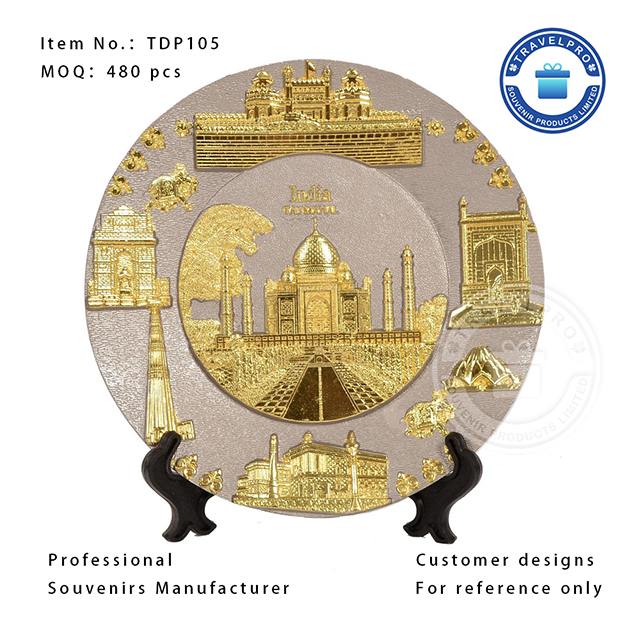
Choosing the right custom plate gauge starts with analyzing your target market. Manufacturers segment materials into distinct tiers. They base these tiers on retail expectations and material performance characteristics.
Economy souvenirs dominate high-volume tourist shops globally. They rely heavily on cheap materials like aluminum or tinplate. These specific metals keep base material costs negligible. They work beautifully for flat printed designs or lightly embossed graphics. You see these pieces sold primarily as impulse buys near the register. However, they carry significant performance risks. This ultra-thin gauge remains highly susceptible to bending. You absolutely cannot use it for deep engraving or intricate 3D sculpting.
This tier represents the strategic sweet spot for most mainstream manufacturers. Factories typically use brass, iron, or copper here. It perfectly supports standard stamped souvenir plates. You can safely incorporate soft enamel color fills. You can also achieve moderate 3D relief without risking structural failure. It balances reliable structural integrity with highly manageable material costs. Most mid-tier retail keepsakes fall squarely into this versatile category.
High-end collectibles demand substantial physical heft. Premium products utilize zinc alloy for precision die-casting. They also use heavy brass or bronze blanks. This robust thickness allows for dramatic multi-level 3D sculpting. You can achieve deep mechanical engraving safely. Factories can also apply complex antique finishes. It serves as the standard for any luxury plated souvenir plaque, corporate gift, or limited-edition collectible.
Gauge Specifications Reference Chart
| Product Tier | Thickness (mm) | Gauge Equivalent | Primary Materials | Best Application |
|---|---|---|---|---|
| Economy | 0.3 - 0.5 | 24 - 30 | Aluminum, Tinplate | Printed impulse buys |
| Mid-Range | 0.6 - 1.0 | 18 - 22 | Brass, Iron, Copper | Stamped enamel fills |
| Premium | 1.2 - 2.0+ | 12 - 16 | Zinc Alloy, Bronze | Die-cast 3D plaques |
Designers sometimes assume they can choose thickness arbitrarily. In reality, the manufacturing process dictates a strict minimum physical constraint. Understanding these mechanical limits prevents costly engineering failures on the factory floor.
Stamping presses exert immense tonnage to force metal into a hardened die. The starting stock must be thick enough to absorb this violent impact. If it lacks mass, it tears immediately. If you design deep reliefs, you need proportionally thicker base metal. Thin metal will simply sheer under the press, ruining the entire batch. Industry best practices suggest keeping relief depth strictly under one-third of the total metal thickness.
Die-casting injects molten metal into a custom steel mold. This high-heat process requires a specific minimum wall thickness. Engineers typically demand at least 1.2mm for most zinc alloys. If the cavity is too narrow, the molten metal cools prematurely. It stops flowing before filling the mold entirely. This premature cooling creates internal porosity, brittle spots, and incomplete surface designs.
Adding vibrant colors requires stamped recessed cavities. These cavities must be deep enough to hold the liquid enamel securely. Usually, a depth of 0.15mm to 0.2mm works best. Consequently, the base metal must be thick enough to accommodate this recess. If the metal is too thin, creating the cavity compromises its structural integrity. The piece will easily snap or bend along the recessed dividing lines.
Electroplating adds microscopic layers of protective metal. While the plating itself is incredibly thin, the base metal must remain completely rigid. Thin metals naturally flex during everyday handling or shipping. When they flex, rigid plated layers cannot stretch. Plated gold or nickel micro-cracks immediately. Moisture enters these invisible cracks, causing rapid oxidation and ugly tarnishing.
Specifying a heavier gauge elevates overall product quality. However, it heavily influences your broader financial and logistical framework. You must evaluate these scaling factors before approving production.
Tooling expenses jump considerably when you increase metal thickness. Thicker gauges require hardened steel molds to withstand the increased striking force. These premium molds take much longer to CNC machine. They cost more upfront and delay your launch timeline. You must carefully amortize these elevated tooling costs across your expected production volume.
Freight and logistics often present the biggest hidden expense in manufacturing. Metal weight scales linearly with gauge thickness. Moving from a 0.5mm plate to a 1.0mm plate doubles the gross weight of your master carton. You must calculate the exact threshold where upgrading thickness forces a logistical pivot. Air freight becomes prohibitively expensive for heavy metal cargo. You might have to shift entirely to LCL ocean freight due to airline weight limits. This shift drastically alters your lead times and inventory planning.
Compliance and material safety also require vigilant oversight. Some offshore factories try to hit heavy weight targets cheaply. They might mix in heavier, highly toxic alloys like lead or cadmium. This dangerous practice creates severe liability issues in western markets. Always ensure heavier materials rely on safe, compliant base metals. Regular laboratory testing remains an essential best practice for all heavy metal merchandise.
Moving from a digital concept to the factory floor requires precise documentation. Follow this sequential framework to specify the perfect dimensions for your next merchandise project.
Choosing the right thickness for decorative metal plates involves careful calculation. You must balance strict engineering limits, realistic freight economics, and subtle consumer psychology. A poorly gauged product either fails catastrophically during production or alienates the end buyer on the retail shelf.
For most standard tourist merchandise, a 0.8mm brass or iron plate provides the most reliable baseline. It offers enough rigidity for flawless plating while keeping international shipping weights manageable. By dictating strict tolerances in your purchase contracts, you effectively protect your margins and brand reputation.
Next Step: Consult with your manufacturing partner early in the design phase. Ask them to run a direct cost-weight analysis comparing two adjacent gauges before you finalize any tooling investments.
A: Generally, 0.5mm is the absolute minimum for light laser engraving, while mechanical engraving requires at least 0.8mm to prevent warping or punching through.
A: No. Standard electroplating (nickel, gold, silver) adds only a few microns (usually 2 to 5 microns) of thickness. It does not structurally reinforce a plate that is fundamentally too thin.
A: Gauge systems can be confusing as lower numbers mean thicker metal, and the exact millimeter equivalent varies by material (e.g., steel gauge vs. aluminum gauge). Always specify thickness in exact millimeters (mm) or inches on manufacturing spec sheets to avoid expensive miscommunications.
A: Yes. Some manufacturers use a thin stamped shell (0.3mm) and adhere it to a heavier, cheaper base (like MDF wood, plastic, or a secondary pot-metal blank) to achieve the heft of a premium plaque while saving on expensive surface metals like brass.

