
Views: 0 Author: Site Editor Publish Time: 2026-08-20 Origin: Site


It is easy to assume keychains are merely generic, low-value giveaways. We challenge this common misconception completely. You should view them as high-margin, high-retention physical assets instead. They elevate both retail catalogs and promotional programs immensely. However, buyers face intense sourcing pressures daily. You must balance strict unit costs against perceived consumer quality. You also need to manage large inventory scale while ensuring total brand alignment. A fragile accessory reflects poorly on your corporate image. A strategic approach to sourcing a wholesale souvenir keychain requires strict evaluation. You must review hardware specs, demand supplier transparency, and avoid hidden procurement risks. Doing so guarantees positive program ROI. Read on to learn how smart procurement directly enhances retail velocity. You will discover exactly how to protect your budget during mass production.
Strategic Sourcing Yields High Margins: Integrating keychains into bulk programs turns low-cost investments into high-value retail or branding touchpoints.
Specifications Dictate Shelf-Life: Hardware tension, material density, and edge finishing separate premium products from landfill waste.
Customization Balances Lead Time: Choosing the right custom manufacturing method directly impacts unit economics and delivery schedules.
Supplier Vetting is Critical: Avoiding the "golden sample" trap and verifying compliance are mandatory steps before scaling orders.
Many bulk promotional and retail programs suffer from poor product selection. Buyers often default to a harmful "race-to-the-bottom" mindset. They seek the absolute cheapest item available globally. This strategy results in terrible customer perception and dismal financial returns. A flimsy accessory breaks within days of use. Customers immediately toss it into the trash. The solution involves upgrading your entire merchandising strategy. You must prioritize durability and aesthetic appeal over absolute lowest cost.
How do low unit costs combine with high retail value? Profitability explodes when you source smart materials. Tourist shops, artist alleys, and corporate merchandising teams all benefit from this. A quality metal piece feels premium in the hand. Customers gladly pay five to ten times the unit cost. This drives incredible margin velocity for retail stores. Low cost-per-unit metrics remain vital, but perceived value triggers the actual purchase.
You must define clear success criteria early. What makes a bulk programs wholesale souvenir keychain initiative truly successful? Look at sell-through rates first and foremost. Measure your cost-per-impression over a long timeline. Monitor factory defect rates closely. High sell-through proves your chosen design resonates with buyers. Minimal defects ensure you keep your profit margins completely intact.
Inventory efficiency matters greatly for modern retail logistics. Consider your space-to-profit ratio carefully. Apparel requires massive shelving and complex size sorting. Drinkware is fragile and incredibly bulky to store. Keychains require a minimal warehousing footprint by comparison. You can store thousands of units inside a single small box. This maximizes your backend storage efficiency. You effortlessly turn tiny retail shelf spaces into major revenue drivers.
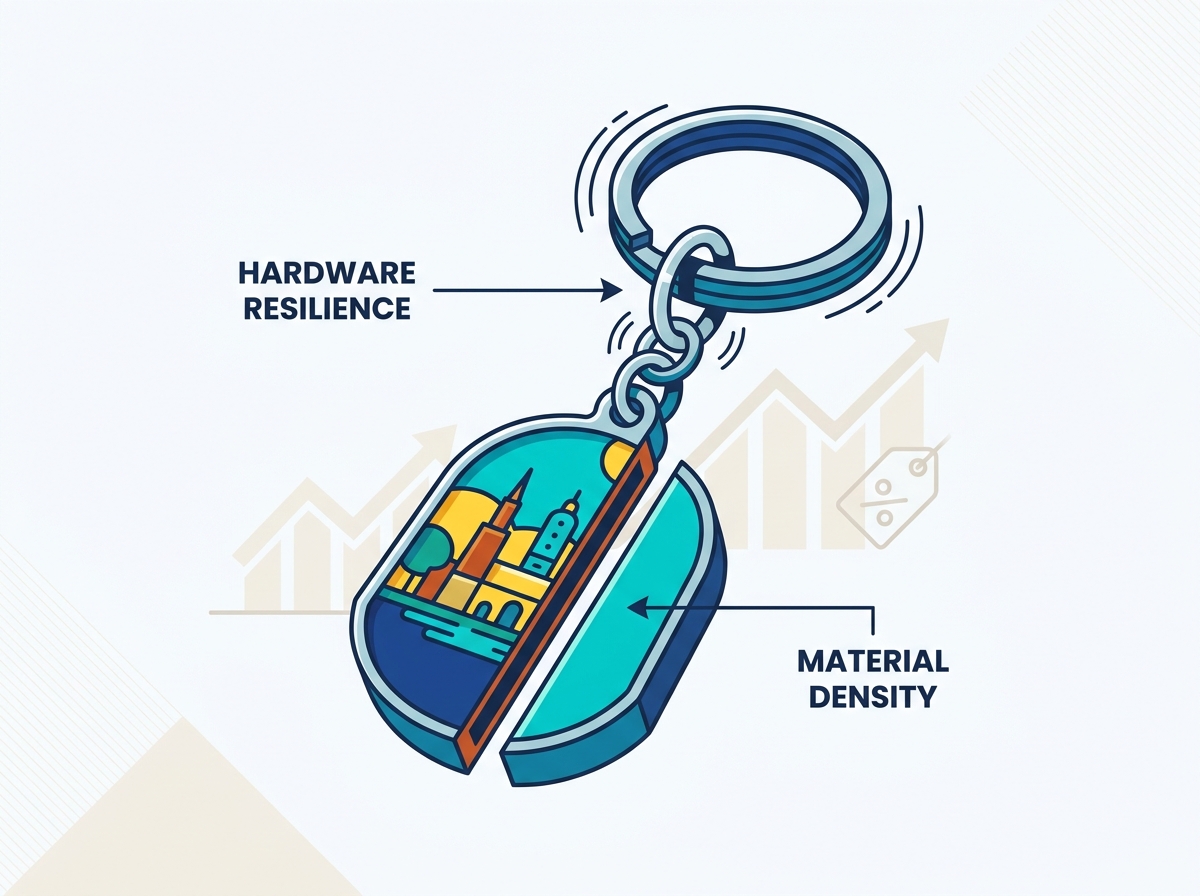
You must establish firm material baselines before ordering. Realities vary wildly between different manufacturing materials. Metal options like zinc alloy or brass offer excellent weight perception. They feel heavy, substantial, and highly durable. However, they carry serious oxidation risks if improperly plated. You must verify plating quality. Alternatively, acrylic and PVC offer distinct visual advantages. They boast high flexibility and brilliant color fastness. They also yield massive weight advantages during global shipping.
Assess the functional hardware components ruthlessly. Hardware resilience ultimately defines the product's lifespan. Focus heavily on split-ring tension retention during testing. A cheap ring deforms permanently after adding just two keys. Check the jump-ring closure strength thoroughly. It connects the main charm to the key ring. Ensure the chain link offers high tensile durability. You must avoid cheap, bendable wire chains completely.
Address common artist and creator pain points next. Evaluate your finish and edge quality very closely. Acrylic pieces require perfectly smooth laser cuts. Sharp acrylic edges feel cheap and present safety hazards. Metal enamel products demand consistent liquid fill levels. Sunken enamel pools or overflowing colors ruin the aesthetic completely. Inspect edge polishing for any burrs or rough patches.
Detailed documentation prevents costly production misunderstandings entirely. You must outline every physical detail beforehand. Defining your exact wholesale souvenir keychain specifications upfront is mandatory. Specify exact Pantone colors, ring diameters, and plating thickness. Detail the specific metal alloy grade you require. This leaves zero room for incorrect factory interpretation. It protects your budget if remakes become necessary.
Customization drives brand uniqueness in a crowded market. You face a core choice between off-the-shelf and custom-molded items. Applying a printed logo to an existing blank saves money. It reduces tooling setup time dramatically. However, investing in custom die-casting creates a completely bespoke shape. Custom-cut shapes command much higher retail prices from consumers. Run a strict cost-benefit analysis here. Does the unique shape justify the initial mold fee?
Different production methods yield vastly different sensory outcomes. Hard enamel feels completely smooth and highly polished. Soft enamel provides a textured, recessed, dimensional feel. Perceived value shifts significantly based on these texture differences. Hard enamel usually commands a premium corporate price. UV printing on acrylic works best for highly complex art. It captures full-color gradients perfectly. It also offers lower setup costs compared to metal molds.
Let us review these manufacturing methods visually. The chart below breaks down ideal use cases.
Production Method | Best Used For | Perceived Value Level | Initial Setup Cost |
|---|---|---|---|
Hard Enamel (Cloisonné style) | Corporate logos, premium retail, high-end souvenirs | Very High (Smooth, polished surface) | Higher (Requires metal mold + intense polishing) |
Soft Enamel | Detailed indie art, textured designs, band merch | Medium-High (Textured surface) | Moderate (Requires metal mold only) |
UV Printed Acrylic | Full-color art, photo gradients, anime charms | Medium (Lightweight, vibrant) | Low (No metal molds required, digital setup) |
Injection Molded PVC | Flexible designs, 3D character mascots, safety items | Medium (Rubber-like, flexible) | Moderate (Requires silicone/steel molds) |
Scalability metrics matter greatly as your merchandising grows. The structural complexity of a custom wholesale souvenir keychain affects future restocks. Complex 3D metal molds carry high initial fees. They also slow down the initial production speed significantly. However, once the factory creates the mold, repeatability becomes effortless. Future restocks run faster and much cheaper. Plan your customization strategy around long-term sales volume.
Sourcing risks destroy bulk order margins if ignored. The infamous "golden sample" trap catches many novice buyers. A factory sends a flawless pre-production prototype for approval. You approve it, but the mass-production run arrives looking terrible. You must ensure bulk runs match the initial prototype quality exactly. Include strict prototype-matching clauses in your formal purchase orders. Require a video inspection before the factory ships the bulk boxes.
Unpack tiered pricing structures carefully during negotiations. Beware of hidden minimum order quantity (MOQ) costs. A factory might offer an unusually low MOQ initially. They do this simply to win your business quickly. However, that low MOQ might inflate per-unit costs to unsustainable levels. Always calculate your exact break-even point. Sometimes ordering 1,000 units costs less total money than ordering 500 units.
Shipping and landed costs often shock inexperienced buyers. Freight forwarders calculate volumetric weight versus actual physical weight. Bulk shipments use whichever number is higher for billing. Dense metal keychains drastically alter freight expenses. They pack into small boxes but weigh a literal ton. Actual weight usually dictates the shipping cost for dense metal. Acrylic ships much lighter, saving your freight budget considerably.
Implement strong quality control standards to avoid catastrophic failures. Use Acceptable Quality Limit (AQL) standards for all mass orders. This establishes a clear, mathematical threshold for refunds or remakes. Here is how to apply AQL correctly for your orders:
Define your critical defects clearly (e.g., broken jump rings, sharp dangerous edges).
Define your major defects precisely (e.g., wrong Pantone color, deep visible scratches).
Define your minor defects realistically (e.g., slight surface scuffs on the back side).
Set maximum allowable percentages for each specific defect category.
Require an independent QC inspection before finalizing your final payment balance.
Setting these rules protects your investment fully. Factories respect buyers who utilize professional QC frameworks.
Choosing the right manufacturing partner determines your ultimate success. Vetting for compliance and safety must come first. Ensure your wholesale souvenir keychain supplier adheres strictly to regional regulations. North American buyers must check Prop 65 compliance diligently. It limits dangerous lead and phthalates in consumer goods. European buyers need strict REACH compliance documentation. Selling non-compliant items exposes your brand to severe legal risks.
Evaluate their communication and prototyping cadence carefully. Fast response times indicate high future reliability. Watch for clarity in their digital proofing process. A good factory spots design flaws very early. They suggest functional improvements before cutting expensive metal molds. Assess their willingness to provide physical samples. Hesitation or refusal here signals a massive red flag.
Demand total production transparency from the beginning. Distinguish between direct manufacturers and third-party trading companies. Trading companies often communicate flawlessly but inflate unit prices. They also lack direct control over the assembly lines. Direct factories offer better pricing but may communicate poorly. Understanding your supply chain tier matters deeply for holding entities accountable.
Use clear shortlisting logic for your final vendor decision. Follow these evidence-based best practices before signing contracts:
Audit verified reviews from previous B2B enterprise buyers.
Conduct a physical sample audit from their past generic production runs.
Negotiate transparent payment terms tied directly to QC milestones.
Draft clear dispute resolution policies before sending any deposit funds.
Successful bulk accessory programs rely entirely on strict procurement controls. You cannot simply hunt for the absolute lowest price globally. Doing so invites poor product quality and severely delayed shipments. You need strict specification controls and evidence-based supplier vetting protocols. Testing hardware tension and verifying enamel finish guarantees a premium feel. This ensures a profitable, high-velocity retail program that delights consumers.
Your next steps require decisive, well-planned action. Direct your purchasing team to follow strict evaluation procedures. Request a physical sample pack from three shortlisted factories immediately. Draft a detailed specification sheet including hardware tension limits and material grades. Finally, calculate your total landed costs before placing any pilot orders. Solid preparation guarantees smooth procurement and protects your profit margins.
A: Standard turnaround times typically range from 15 to 30 days. Creating custom metal molds usually takes 5 to 7 days. Mass production requires an additional 10 to 15 days depending on enamel complexity. Freight methods alter this timeline drastically. Air freight adds 5 to 7 days, while ocean freight adds 25 to 40 days.
A: You must request physical pre-production samples first. Stress-test the hardware by pulling the split rings apart repeatedly. Ensure they snap back without permanent deformation. Scratch the enamel lightly to test for proper curing. You can also request independent QC reports detailing tensile strength from previous production runs.
A: Yes, landed costs often include unexpected fees. You must account for import tariffs, customs brokerage fees, and local duties. Metal items may face different tariff classifications than acrylic items. Always ask your freight forwarder for a DDP (Delivered Duty Paid) quote to avoid surprise last-mile delivery fees.
A: It depends on the production method. For metal keychains, each unique shape requires a separate mold fee. However, you can often mix enamel colors within the same mold for a small fee. For UV-printed acrylic, suppliers frequently allow design mixing because digital printing requires no physical molds.

