
Views: 0 Author: Site Editor Publish Time: 2026-09-09 Origin: Site


In souvenir manufacturing, a harsh reality often goes unnoticed. An improperly sized connecting hoop can easily ruin the perceived value of a beautifully designed charm. Consumers notice flimsy hardware instantly. This single misstep often leads to frustrating returns or painfully slow retail sell-through. Specifying your hardware requires precise technical communication. Visual approximations simply fail during mass manufacturing. You cannot rely on a factory to guess your intended proportions. They need exact measurements and clear structural directives.
This article serves as a technical evaluation guide for product developers and retail buyers. You will learn how to define the correct specifications precisely before authorizing bulk runs. We will explore materials, standard gauges, and secure assembly methods. You can implement these frameworks immediately to elevate your next product line. Mastering these details protects your profit margins and ensures a superior customer experience.
Hardware choices directly influence how consumers perceive your product. Undersized components make premium die-cast metals feel incredibly cheap. Buyers associate thin, fragile rings poorly manufactured novelty items. Conversely, oversized hardware completely overwhelms delicate acrylic designs. The heavy metal visually swallows the core artwork. You must strike a careful balance. Perfect proportions signal high manufacturing standards. This attention to detail justifies premium retail pricing.
Retail display realities present another major hurdle. Your products must hang cleanly in physical stores. Substandard retail keychain hardware often fails to fit standard store pegboards. When a ring lacks the proper internal clearance, it forces the packaging to sit awkwardly. Crooked products look messy on the rack. Messy displays actively repel potential buyers. Store managers despise struggling to merchandise poorly designed packaging.
Finally, usability determines the long-term success of your product. A perfectly balanced charm means nothing if the end-user cannot attach their keys. An overly stiff ring creates severe consumer friction. Extremely thick wire profiles destroy fingernails. If buyers struggle to use your product, they will quickly discard it. They might even leave negative reviews. We highly recommend testing the usability yourself. Add standard house keys to your prototypes. Rate the experience before you approve the design.
Navigating hardware specifications requires absolute clarity regarding dimensions. You must understand the critical difference between outer diameter (OD) and inner diameter (ID). B2B suppliers typically quote the outer diameter by default. If you ask a factory for a 30mm ring, they will measure across the outside edges. If you secretly needed 30mm of internal clearance, your final product will arrive too small. Always define your measurement points explicitly. Specify OD in every single technical document.
You can optimize your designs by relying on established industry baselines. Understanding the standard keychain split ring size helps you make faster decisions. The 25mm size serves as a perfect baseline for lightweight items. We typically recommend this size for flexible PVC or small acrylic charms. It keeps the overall unit cost low. More importantly, it prevents the hardware from dominating the design visually.
The 28mm dimension represents the universal middle-ground. It serves as the undisputed workhorse of the industry. You should default to this size for standard enamel pins or lightweight metal charms. It provides ample room for standard keys. Meanwhile, the 30mm to 32mm range handles heavy, 3D, or multi-charm souvenirs. Large custom shapes demand this substantial foundation. Anything smaller on a heavy item looks unbalanced.
Wire thickness considerations matter just as much as diameter. We refer to this as the wire gauge. A large ring requires thicker wire. A 28mm ring typically requires a 1.8mm to 2.0mm wire thickness. This gauge maintains crucial tension memory. If you stretch a thin wire over a large diameter, it loses its spring. The ring will permanently deform after a single use. The keys will simply fall out.
Standard Hardware Dimensions Matrix
| Outer Diameter (OD) | Ideal Charm Material | Recommended Wire Gauge | Common Use Case |
|---|---|---|---|
| 25mm (~1.0 inch) | PVC, Thin Acrylic | 1.5mm - 1.8mm | Lightweight promotional items |
| 28mm (~1.1 inches) | Enamel, Wood | 1.8mm - 2.0mm | Standard retail souvenirs |
| 30mm (~1.18 inches) | Die-Cast Zinc, Multi-charm | 2.0mm - 2.2mm | Premium 3D designs |
| 32mm (~1.25 inches) | Heavy Brass, Large Tools | 2.2mm+ | Utility and heavy-duty items |
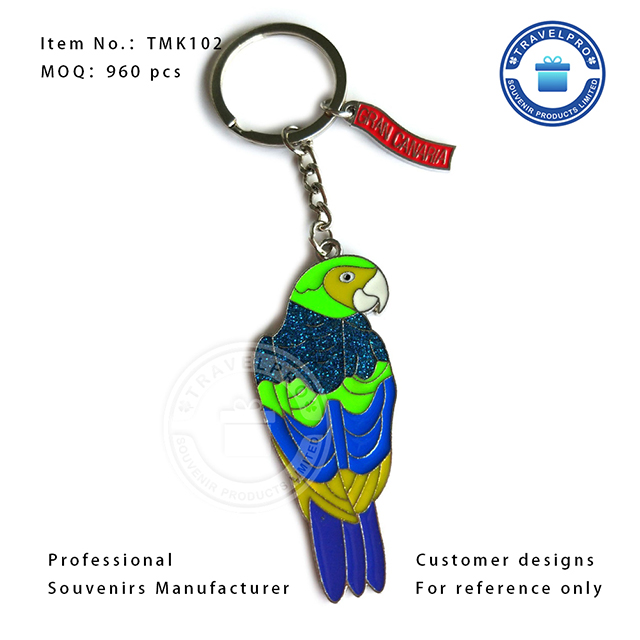
Every material behaves differently in the user's hand. Acrylic and wood represent the lightweight end of the spectrum. These materials require a delicate touch during specification. Over-specifying your diameter creates a severe center of gravity problem. When the hardware outweighs the charm, the product hangs poorly. It spins awkwardly in the user's hand. We recommend sticking strictly to 25mm or 28mm for these materials. Always pair them with standard flat wire to maintain a sleek profile.
Die-cast zinc and soft enamel sit squarely in the medium to heavy categories. These popular materials demand robust structural support. If you place a standard metal key ring under 28mm on a heavy die-cast souvenir, it looks completely disproportionate. The product feels alarmingly insecure. Consumers intuitively sense this mismatch. They will hesitate to trust the item with their car keys.
You must scale up your hardware for heavier items. Moving to a 30mm diameter instantly elevates the perceived durability. Upgrading the surface finish also helps. Consider specifying a textured or beveled edge for the ring itself. A flat-pressed wire profile reflects light beautifully. It makes the entire assembly look significantly more expensive. This minor adjustment costs pennies per unit but adds massive retail value.
The main hoop only represents half of the battle. You must carefully engineer the connection points. The small jump ring acts as the primary bridge. This tiny connecting piece represents the most common failure point in the entire assembly. Factories often rush this step. They fail to close the jump ring completely. We strongly advise specifying unsoldered jump rings strictly for lightweight items. Heavy items require a thicker, fully closed linkage to survive daily wear.
Tension loss creates another massive liability. We call this the dreaded "gap" issue. This occurs when you force a thick souvenir attachment into a tight split ring. If the factory pushes a thick metal loop into the split ring, it stretches the steel permanently. The ring loses its tension memory. A permanent gap forms. Keys slip through this gap effortlessly. You must adjust the split ring's tolerance to accommodate the thickness of your specific attachment.
Understanding when to use extensions saves you from costly redesigns. Swivel bases and chain extensions serve very different purposes. You should use a short chain extension for thick, 3D items. A chunky die-cast building needs physical clearance to rotate freely. Conversely, flat enamel items perform much better a direct jump ring. Removing the chain keeps the overall length short. Shorter products fit neatly inside smaller polybags. This reduces your shipping volume and packaging costs.
Manufacturers rarely challenge vague instructions. They simply choose the cheapest available components to fill the blanks. You must write a bulletproof specification sheet to protect your vision. A robust "tech pack" eliminates guesswork. It clearly defines every structural expectation. Do not rely on email chains. Put all requirements into a single, central document. This document acts as your final standard for quality control inspections.
Drafting the ideal specification requires methodical detailing. Provide this exact breakdown to your manufacturing partner. State your target outer diameter explicitly in millimeters. Never use vague terms like "medium size." Next, define your wire profile. You must specify whether you want flat-pressed wire or standard round wire. Then, dictate the exact material composition. Iron serves most basic needs. However, coastal tourist destinations demand zinc alloy or stainless steel to prevent rapid rusting. Finally, list your precise plating requirements. Highlight any need for nickel-free finishes.
A rigorous prototyping protocol validates your written specifications. Never authorize mass production based on a specification sheet alone. You must demand a physical pre-production sample (PPS). The factory must assemble this sample fully. Once it arrives, test the overall drape. Evaluate the weight distribution in your palm. Add a few household keys to verify the chosen key ring diameter functions perfectly. Only sign off on the bulk run after approving this physical test.
Specifying the proper hardware requires technical precision and material awareness. You cannot treat the connecting hardware as an afterthought. It stands as a vital structural decision. Proper specifications protect your design integrity. They elevate the perceived value of your items. Correctly sized components ensure your products hang perfectly on retail displays. Most importantly, durable connections guarantee long-term usability for the end consumer.
You should immediately audit your current product lines. Pull your best-performing SKUs from the warehouse. Measure their hardware using precise digital calipers. Document these exact dimensions. Update your supplier tech packs to lock in these proven baselines. By standardizing your technical communication, you eliminate manufacturing errors. You secure better margins and deliver a vastly superior product to the retail market.
A: 25mm and 28mm (OD) are the undisputed industry standards for mass-market promotional items. They offer high cost-efficiency and ensure universal key compatibility for everyday consumer use.
A: Unless explicitly stated otherwise, factories measure the Outer Diameter (OD). Always confirm this detail in writing to avoid receiving undersized hardware.
A: Flat-pressed rings appear visually wider and feel significantly more robust. You can often specify a slightly smaller diameter, like a 28mm flat ring instead of a 30mm round ring, achieving a premium look while saving material weight.

