
Views: 0 Author: Site Editor Publish Time: 2026-08-30 Origin: Site


Sourcing the perfect branded merchandise often feels like a frustrating guessing game for many professionals. Procurement teams frequently face confusing technical specifications when ordering neckwear for corporate events, tradeshows, or daily staff use. Selecting the right specifications for a printed promotional lanyard directly impacts brand perception, unit cost, and overall durability. A simple mismatch between your artwork complexity and the chosen printing technology quickly leads to blown budgets, delayed lead times, or completely illegible logos. We created this comprehensive guide to provide an objective, vendor-neutral framework for evaluating various production methods. You will learn exactly how to mitigate common design risks, understand material constraints, and successfully finalize your procurement specifications. Read on to master the selection process, avoid standard production pitfalls, and ensure your next branding project succeeds effortlessly from start to finish.
Procurement teams must understand the physical mechanisms behind different printing methods. Each technology interacts differently with fabric substrates. This interaction defines the final look, feel, and longevity of your branded merchandise.
Mechanism: Factory operators create a custom stencil, also known as a screen, for each color in your design. They press wet ink through this mesh stencil directly onto the lanyard material. Most manufacturers use flat polyester or tubular nylon for this process. The ink bonds to the surface of the fabric and cures through a heating tunnel.
Best for: This method works perfectly for solid colors, high-contrast text, and simple vector logos. Buyers operating under strict budget constraints often choose silkscreening for bulk orders. It delivers sharp, easily readable text from a distance.
Limitations: Silkscreening cannot reproduce gradients, shading, or fine photographic details. Because the ink sits on top of the fabric rather than penetrating the fibers, it remains vulnerable to physical abrasion. Heavy, long-term friction will eventually cause the printed logo to crack, flake, or fade.
Best Practice: Keep designs to one or two solid colors. More colors require more screens, which increases setup costs and misalignment risks.
Mechanism: Instead of applying wet ink to the surface, this process uses specialized digital printers to print the design onto transfer paper. High-temperature heat presses then push the paper against the fabric. The heat converts the ink into a gas, embedding it directly into the polyester fibers. The design essentially becomes part of the fabric.
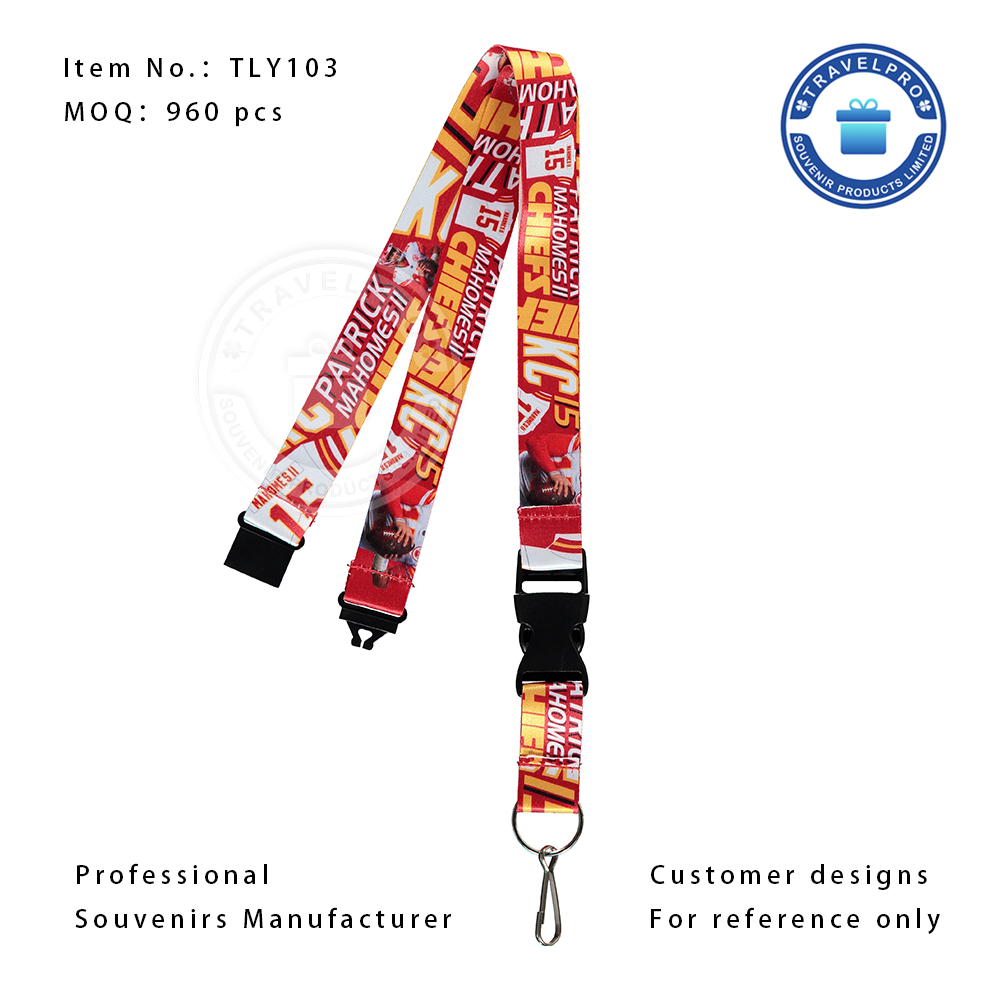
Best for: Dye sublimation excels at edge-to-edge printing and intricate designs. It is the only reliable way to produce a highly detailed custom pattern lanyard containing multiple colors, background textures, or continuous tones.
Limitations: This technique generally requires smooth polyester to hold the gaseous dye properly. Exact Pantone (PMS) color matching proves more challenging here. The intense heat required for transfer often causes a slight color shift, meaning the final fabric color might vary slightly from a digital monitor.
Common Mistake: Do not attempt dye sublimation on textured nylon or cotton. The fabric must contain a high percentage of polyester polymers for the gaseous ink to bond successfully.
Mechanism: Woven lanyards do not use ink at all. Instead, industrial Jacquard looms physically weave the design into the strap using colored polyester threads. The logo becomes an integral structural component of the strap itself.
Best for: Organizations choose woven styles for premium brand perception and extreme durability. They work beautifully for simple, bold text and classic corporate branding. The physical texture adds a high-end, tactile element to the product.
Limitations: Looms cannot handle complex logos, fine text, or gradients. The mechanical weaving process relies on distinct threads, resulting in a slightly blocky appearance for curved designs. This method also commands a higher unit cost and requires longer production setup times.
Comparison Chart: Core Technology Specifications
| Printing Technology | Ideal Artwork Complexity | Fabric Penetration | Durability Profile | Setup Speed |
|---|---|---|---|---|
| Silkscreen | Low (Solid spots, clear text) | Surface level only | Moderate (Cracks over time) | Fast |
| Dye Sublimation | High (Gradients, photos) | Deep fiber integration | Excellent (Zero fading/cracking) | Fast |
| Woven (Jacquard) | Low (Bold, blocky shapes) | Structural (Woven threads) | Maximum (Tear/wear resistant) | Slow |
Selecting a printing technology based solely on aesthetics often leads to failure in the field. You must analyze the physical environment where users will wear the item. Environmental stressors dictate which production method will survive the intended lifespan.
Criteria: Event organizers prioritize low unit costs, fast turnaround times, and high visibility. Thousands of attendees need immediate identification, but the items only need to survive a few days.
Recommendation: Choose silkscreen printing on tubular or flat polyester. As an event neck strap, long-term wear-and-tear is not the primary success metric. A simple, bold logo printed in one color on a contrasting fabric delivers maximum brand impact at the lowest possible price point.
Criteria: Daily wear demands high washability, resistance to friction fading, and a continuously professional appearance. Employees rub these straps against desks, seatbelts, and outerwear constantly.
Recommendation: Select woven construction for simple logos or dye sublimation for complex branding. Neither of these methods relies on surface ink. Therefore, the design will not peel, flake, or scratch off over time. Medical environments particularly benefit from dye sublimation because smooth polyester straps wash easily without degrading the logo.
Criteria: Retail environments demand intense aesthetic appeal, strict color accuracy, and multi-color complexity. Consumers buy these items for their visual design rather than mere utility.
Recommendation: Dye sublimation stands as the undeniable champion here. It allows for edge-to-edge artistry. This method remains ideal when the item serves as a standalone retail product, a music festival memento, or a premium tourism promotion item.
Even the best conceptual design can fail on the factory floor if procurement teams ignore technical manufacturing constraints. Understanding these implementation realities protects your budget and timeline.
Submitting improper artwork files remains the number one cause of production delays. High-resolution raster files like JPEGs and PNGs frequently fail in production. Raster images rely on finite pixels. When a manufacturer enlarges a raster logo to fit a printing template, the edges become blurry and pixelated.
Production facilities necessitate outlined fonts and layered vector files (such as .AI, .EPS, or .SVG). Vector files use mathematical formulas to dictate shapes, meaning they scale infinitely without losing sharpness. Clean vector separations allow print technicians to isolate individual colors for silkscreen stencils accurately.
Every procurement professional expects their brand colors to match perfectly. However, exact Pantone Matching System (PMS) accuracy varies wildly across different fabric bases and ink types. A lanyard print method relying on CMYK digital blending (like dye sublimation) cannot always hit a precise spot color target. Furthermore, printing a bright yellow logo onto a dark blue polyester base often results in a murky, green-tinted final product unless the manufacturer applies an expensive white underbase.
Pairing the wrong fabric with the wrong ink guarantees poor results. Ribbed or heavily textured materials like rugged nylon cause liquid ink to bleed along the fabric channels. This ruins small text. Smooth polyester provides a much safer, flatter canvas for crisp lines. Always match your material texture to your design's level of detail.
Budgeting requires understanding how vendors structure their pricing. Silkscreening involves physical labor to burn screens and mix inks. Consequently, vendors charge initial screen setup costs per color, making small runs expensive. Conversely, dye sublimation relies on digital printing. It features much lower setup barriers, but the per-unit cost often runs higher. Therefore, small orders frequently lean toward digital sublimation, while massive bulk orders lean toward silkscreening to amortize the setup fees.
Table: Setup Cost vs Volume Comparison
| Order Volume | Most Cost-Effective Method | Primary Cost Driver |
|---|---|---|
| Under 250 units | Dye Sublimation | Per-unit material/time costs |
| 250 - 1,000 units | Variable (Depends on colors) | Artwork complexity & screens |
| Over 1,000 units | Silkscreen (1-2 colors) | Initial screen setup fees |
Transitioning from research to purchasing requires a systematic approach. Follow this standardized framework to eliminate guesswork and communicate clearly with manufacturing partners.
Procuring branded neckwear involves far more than picking a color and sending a logo. As we explored, no single printing method is universally superior. The correct choice remains entirely dependent on your specific artwork complexity, budget constraints, and intended product lifespan. Silkscreening offers unbeatable bulk pricing for simple designs, dye sublimation unlocks unlimited creative freedom, and woven methods provide unmatched tactile durability.
Before soliciting quotes from vendors, take the following action steps:
By preparing these specifications in advance, you ensure accurate vendor comparisons, prevent costly production delays, and guarantee a high-quality product representing your brand flawlessly.
A: Yes, but only via dye sublimation (heat transfer). Silkscreen and woven methods cannot process continuous tones or photographic details. Sublimation uses digital CMYK blending to recreate highly detailed, photorealistic imagery directly inside the fabric fibers.
A: Surface-level silkscreen ink can crack or peel over time due to friction. When wearers rub the fabric against desks or clothing, the physical ink layer deteriorates. For heavy-duty use, embedded dye sublimation or woven methods are recommended.
A: Yes. Smooth polyester is universally adaptable, while textured nylon is better suited for silkscreening, and tubular fabrics are generally restricted to simple screen prints. Applying digital heat transfers to heavily textured materials often results in blurry, distorted imagery.
A: Breakaways require the lanyard to be cut and stitched at the back of the neck. Artwork must be formatted with safe zones to prevent critical logo elements from being caught in the seam. Always leave a blank gap in the design pattern where the hardware connects.

