
Views: 0 Author: Site Editor Publish Time: 2026-08-19 Origin: Site


Purchasing national flag accessories requires balancing strict visual accuracy against physical wearability on professional garments. Official flag proportions and precise heraldic colors must translate perfectly into a rigid medium. Selecting the wrong dimension causes a cascade of visual and practical issues. Poorly sized items result in illegible heraldry, bleeding colors, or incorrect aspect ratios. Furthermore, top-heavy designs tend to rotate awkwardly during crucial events. They can also snag or permanently damage delicate suit fabric over time.
Our primary goal is to provide buyers, protocol officers, and corporate event planners a highly structured technical framework. You will learn how to evaluate specific manufacturing constraints properly. We will guide you through the process to select the exact geometric specifications needed. You can use these practical guidelines to confidently produce professional-grade flag accessories.
Understanding baseline dimensions provides a solid starting point for any custom production run. Every size category serves a distinct aesthetic purpose. You must match the dimension to both the intended environment and the specific national flag design.
This compact size remains best for simple bi-color or tri-color flags. Examples include the national flags of France, Italy, and Japan. This dimension proves highly suitable for strict corporate or diplomatic protocol. Diplomatic environments often require extreme understatement. A tiny accessory adds a touch of patriotism without distracting from the speaker. It keeps the viewer focused on the wearer's face rather than their clothing. However, you must avoid this size if the design contains complex central emblems.
Most organizations consider the one-inch width the universal industry standard. It perfectly balances readability against daily wearability. This dimension accommodates moderate detail beautifully. You can easily render the maple leaf of Canada or the twelve stars of the EU flag at this scale. A one-inch piece fits neatly on standard suit lapels without extending past the buttonhole seam. We recommend this size for 80% of corporate uniform projects.
You must reserve these larger dimensions for highly detailed designs. Flags representing Mexico, Spain, or the USA require extra surface area. The Mexican flag features an intricate central eagle. The US flag demands precise spacing for fifty individual stars. Trying to compress these elements into smaller sizes guarantees failure. Additionally, dual-flag "friendship" crossed-pole designs necessitate this larger range. Two separate national symbols must share the same physical footprint. Therefore, you need at least 1.25 inches to keep both sides legible.
Table: Baseline Sizing Reference for National Flags
| Dimension Width | Detail Capacity | Ideal Flag Types | Common Use Case |
|---|---|---|---|
| 0.75 Inches | Low | Simple Tri-colors (France, Italy) | Strict Diplomatic Protocol |
| 1.0 Inches | Medium | Moderate Elements (Canada, EU) | Standard Corporate Uniforms |
| 1.25 - 1.5 Inches | High | Complex Crests (Spain, Mexico) | Crossed-Flag Friendship Pins |
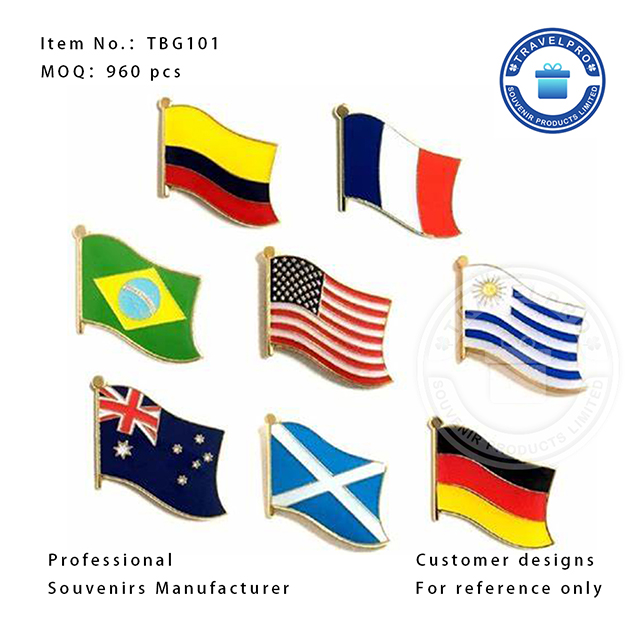
Aesthetic preferences often clash against hard manufacturing realities. You cannot simply choose a size based on personal taste. The geometric construction of the flag dictates the absolute minimum production footprint.
Enamel manufacturing requires thin metal ridges to separate liquid colors. Industry professionals call these ridges "cloisons." Liquid enamel needs adequate physical space to pool and set properly. If a piece becomes too small, these metal borders merge together. Complex elements turn into unreadable metal blobs. For example, rendering the 50 stars on the US flag requires precise microscopic borders. Shrinking this design too aggressively forces the factory to remove stars entirely. This violates flag accuracy standards. You must provide enough surface area for the factory to inject color cleanly.
National flags have legally defined proportions. The UK Union Jack utilizes a 1:2 ratio. The Swiss flag utilizes a strict 1:1 square ratio. These geometric rules heavily influence your sizing decisions. Consider scaling a 1:2 flag to a standard 1-inch width. This mathematical reduction results in a 0.5-inch overall height. A half-inch height feels visually insignificant on a broad suit jacket. To achieve an acceptable vertical presence, you must bump the width to 1.25 inches. Always calculate the final height before finalizing the horizontal dimension.
Metal plating finishes dramatically impact visual clarity. Factories offer various plating options like gold, silver, or black nickel. You must assess whether the required metal plating will overpower the enamel colors. Smaller dimensions suffer disproportionately from thick metal borders. A gold outline might look elegant on a 1.25-inch piece. However, that same gold line thickness will completely swallow the colored sections of a 0.75-inch piece. Carefully evaluate line weight restrictions during the initial artwork phase.
Physical accessories interact directly with garment mechanics. You must evaluate how the finished piece will behave on various fabrics. Failure to account for physics ruins the wearer's experience.
Heavy, oversized accessories will drag down thin suit lapels. They also pull awkwardly on delicate silk blouses. Pieces exceeding 1.25 inches often require thicker base metals to prevent bending. This added material increases the total weight significantly. A heavy metal accessory severely impacts the natural drape of lightweight summer garments. We advise matching the item's weight to the seasonal wardrobe of your staff.
Gravity constantly acts upon asymmetrical designs. Any item wider than 1 inch becomes highly susceptible to spinning out of alignment. This rotation happens frequently if you secure the piece using only a single butterfly clutch. The fabric acts as a pivot point. The heavier side of the item naturally falls downward. You will constantly find yourself adjusting the piece throughout the day. This creates a messy, distracted appearance during professional interactions.
In diplomatic and military contexts, presentation rules remain uncompromising. The national flag must never be obscured. Wearing a national symbol upside down violates core protocol standards. It often signals distress or extreme disrespect. An oversized item rotating freely creates these embarrassing situations inadvertently. You must engineer the piece to remain perfectly static. Proper sizing ensures compliance regarding respectful display guidelines.
Many organizations waste thousands of dollars producing unusable accessories. You can avoid these expensive mistakes by recognizing common industry pitfalls. We have identified several recurring failures during bulk production runs.
Approaching factories without a clear specification sheet leads to production delays. You need a standardized methodology to evaluate your artwork. Follow this exact sequence to determine your optimal manufacturing specifications.
Selecting the correct size remains a critical structural decision, not just an aesthetic one. It requires matching the geometric reality of the national flag against hard physics. You must balance intricate detailing requirements against the limitations of enamel manufacturing. Furthermore, you must consider garment wearability to ensure long-term comfort.
Consult your chosen manufacturer immediately. Provide them your exact flag vector file. Ask their engineering team to determine the absolute minimum size required to render its most complex element cleanly.
A: The 1-inch (25.4mm) width serves as the universal standard. It offers a perfect balance between visible detail and a professional appearance. This specific dimension fits neatly on standard suit lapels. It prevents the accessory from appearing visually intrusive during formal business meetings.
A: It is generally not recommended. Factories can easily cut the base metal smaller. However, the liquid enamel used for coloring requires a minimum area to adhere properly. Shrinking the piece too much means fine visual details will be lost or merged entirely.
A: Yes. Two distinct flags constantly compete for space within the same layout footprint. Because of this shared space, crossed-flag items typically start at 1.25 inches. This extra width ensures both national symbols remain clearly identifiable from a reasonable distance.
A: Gravity easily rotates wider pieces. Any item wider than 1 inch requires reinforced stability. You should order these larger pieces equipped utilizing two attachment posts. Alternatively, request a built-in metal anti-spin spur on the back to lock the hardware firmly into the fabric.

