
Views: 0 Author: Site Editor Publish Time: 2026-10-21 Origin: Site


Designing a profitable souvenir line starts by selecting the right core product. Custom souvenir plates represent a high-margin opportunity for heritage sites, corporate events, and boutique retailers. Poor execution, however, often leads to inventory write-offs. You might face breakage, rapid color fading, or a misaligned brand perception if you cut the wrong corners. Buyers must carefully balance perceived retail value against basic unit economics. Specifically, you need to navigate the strict trade-offs between material durability, print fidelity, and transit-safe packaging.
This vendor-neutral evaluation framework helps you align material choices, printing technologies, and retail packaging strategies. By following this guide, you will consistently meet your target ROI while exceeding audience expectations. You will learn how to evaluate materials, choose printing methods, and structure packaging for maximum success. Let us explore the critical steps required to build a reliable and visually stunning souvenir collection.
Before selecting materials or manufacturers, you must define the primary function of your product. Categorizing the product's primary lifecycle establishes the foundation for every subsequent decision.
You need to decide how buyers will use the product in their daily lives. We typically divide plates into three distinct categories:
End-use dictates your regulatory burden. If you plan to sell functional dinnerware, you face strict food-safe requirements. You must specify non-toxic, lead-free glazes. The underlying substrates must also meet FDA or EU food-grade standards. Failing to secure these certifications exposes your brand to severe liability.
Conversely, decorative plates offer more creative freedom but carry distinct limitations. If you use specific metallic inks or low-fire decals, they are not food-safe. In these cases, clear labeling becomes mandatory. You must permanently affix a "Not for Food Use" warning to the back of the item to ensure consumer safety.
Your intended use directly impacts Minimum Order Quantities (MOQs) and unit costs. High-end ceramics require complex kiln firings, which often demand higher MOQs to offset setup fees. Meanwhile, event-grade paper products allow for massive runs at pennies per unit. You must calculate the expected retail markup early. A premium museum replica might support a 400% markup, while a promotional giveaway yields zero direct retail revenue. Aligning your budget with the expected application ensures you do not over-engineer a disposable item or under-deliver on a luxury keepsake.
Choosing the right substrate determines the physical weight, perceived value, and logistical complexity of your product.
Ceramic and porcelain dominate the traditional souvenir market. They offer exceptional weight and a classic aesthetic. Consumers intuitively associate heavy porcelain with high perceived value, making it easier to justify premium pricing.
However, this material category carries notable risks. Ceramics possess a high shipping weight, which significantly increases freight costs. Furthermore, they present a massive breakage risk during transit. You cannot ship ceramics securely without engineered packaging. A poorly packed pallet of porcelain can easily result in a 20% loss rate before reaching the retail floor.
Metals provide a rugged, vintage alternative to fragile ceramics. They offer a zero breakage risk. This durability drastically lowers replacement costs and simplifies warehousing. They also weigh less than ceramics, reducing overall shipping costs.
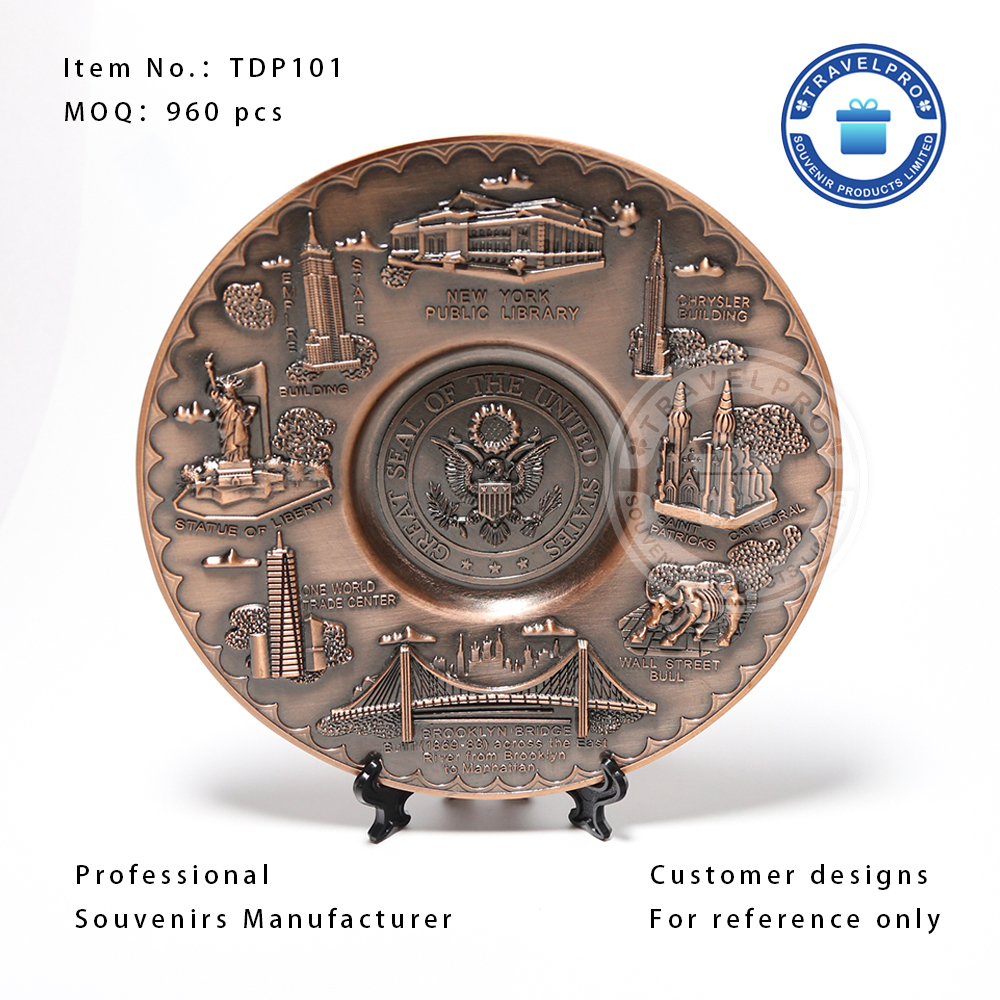
Metals hold high vintage appeal, making them perfect for specific niches. For instance, utilizing an embossed metal souvenir plate for heritage brands or rustic tourist destinations creates immediate tactile differentiation. The raised textures catch the light and offer a premium feel completely distinct from standard flat printing.
For large-scale events, paper and bio-composites serve as the ultimate high-volume solution. They deliver incredibly low costs at scale. Moreover, they support eco-friendly and biodegradable claims, which align perfectly with modern corporate ESG (Environmental, Social, and Governance) goals. Production times are also exceptionally rapid.
The primary risk involves lower perceived retail value. Consumers rarely view paper goods as permanent keepsakes. Additionally, paper requires structural coatings to prevent moisture degradation. You must apply treatments like wax or PLA (Polylactic Acid) to maintain structural integrity during use.
| Material Category | Primary Application | Perceived Value | Transit Breakage Risk |
|---|---|---|---|
| Ceramic / Porcelain | Premium Retail, Boutiques | High | High (Requires custom packaging) |
| Tin / Metal Alloys | Heritage Sites, Vintage Brands | Medium to High | Zero |
| Paper / Bio-Composites | Festivals, Corporate Events | Low | Low |
Your chosen material dictates the printing technologies available. Selecting the wrong print method often results in fading designs or peeling artwork.
Kiln-fired decals represent the industry standard for ceramics. The mechanism relies on water-slide decals applied manually to the substrate. The factory then bakes these decals into the glaze at extremely high temperatures.
When evaluated, this method provides exceptional scratch resistance. The artwork essentially becomes one continuous surface along side the glaze, ensuring incredible longevity. However, it demands higher setup costs due to the labor-intensive application. It also requires much longer lead times compared to digital methods.
Dye sublimation excels at capturing intricate details. The mechanism involves heat-transferring ink directly into a specialized polymer coating applied to the plate. The heat turns the solid ink into a gas, which permeates the polymer layer.
This process evaluates perfectly for small batches. It reproduces full-color photographs flawlessly. Unfortunately, dye sublimation is highly susceptible to fading over time. If consumers expose these items to direct, prolonged UV light, the vivid colors will eventually wash out.
UV printing and stamping offer modern efficiency. The mechanism cures liquid ink instantly via concentrated UV light. Alternatively, mechanical presses physically stamp designs into the material.
This method is highly scalable, especially for packaging and metal substrates. It allows for raised textures and striking visual contrast. However, you must perform rigorous adherence testing. UV inks sometimes struggle to bond perfectly to ultra-smooth, untreated metal substrates without a proper primer.
Sourcing excellent custom souvenir plates means little if they arrive shattered. Packaging serves as both a protective fortress and a brand ambassador.
You must distinguish between bulk protective shippers and individual point-of-sale boxes. B2B transit packaging focuses purely on logistics. It groups multiple items securely to survive freight handling. Conversely, B2C retail packaging focuses on the consumer. It must look attractive on a shelf while providing enough localized protection for the trip home in a shopper's bag.
When dealing with ceramics, protective engineering becomes paramount. You must evaluate various insert materials:
You also need to balance drop-test performance against dimensional weight (DIM) shipping costs. Over-packing increases the box size. Carriers calculate freight based on volume as well as physical weight. An excessively large box will destroy your profit margins through inflated DIM charges.
Packaging should elevate the perceived value. Integrating custom-printed presentation boxes grabs attention on crowded retail shelves. Adding acetate windows allows shoppers to view the artwork without opening the box, reducing floor damage.
Consider adding rigid display stands directly into the packaging architecture. This provides immediate utility for the buyer. Finally, prioritize sustainability. Eliminating single-use plastics in favor of structural paperboard appeals strongly to modern consumers and meets tightening global retail regulations.
Your supply chain is only as strong as your manufacturing partner. Evaluating vendors systematically prevents costly errors during mass production.
Do not accept marketing claims at face value. Request official audit reports for ethical sourcing. Ask for Material Safety Data Sheets (MSDS) to verify glaze toxicity levels. These documents prove a factory operates legally and safely.
Assess their in-house packaging capabilities as well. Can the factory kit the plate and box together on the assembly line? If they cannot, you will require third-party fulfillment. Moving fragile items between a primary manufacturer and a secondary packaging facility drastically increases both costs and breakage risks.
Always demand a transparent breakdown of tooling costs. Tooling for embossed metals requires heavy upfront investment for steel molds. Similarly, screen and plate fees for traditional printing can escalate quickly if your design uses multiple colors. Understanding these fixed costs helps you calculate the true break-even point for your desired MOQ.
Never skip the prototyping phase. Ordering a pre-production sample (PPS) is absolutely critical. A physical PPS verifies color accuracy, which often shifts dramatically between a computer screen and a kiln-fired glaze. It allows you to confirm the material weight and tactile feel. Most importantly, it lets you test the packaging fit before authorizing mass production. Catching a structural failure during the PPS phase costs a few hundred dollars; catching it during mass transit costs your entire investment.
Sourcing profitable souvenir items requires a deeply holistic approach. You must actively align material durability, print compliance, and packaging logistics from day one. Do not treat packaging as an afterthought; it remains fundamentally integral to the product's landed cost and retail viability. Your next action is clear: define your specific functional requirements regarding food safety versus decorative display. Once defined, reach out to a vetted manufacturer and request a physical material sample or a structural packaging prototype to begin your project securely.
A: Lead times vary significantly based on material and location. Local paper printing or dye sublimation usually takes 2 to 4 weeks. Conversely, overseas custom ceramics require much longer. You should expect an 8 to 12-week timeline for ceramics to account for kiln firing, quality control, and ocean freight logistics.
A: Yes, but you must specify this requirement upfront. Obtaining food-safe certification requires the use of FDA/EU-approved food-grade inks and high-fire glazing processes. Not all print methods qualify. Dye sublimation and certain UV inks typically fail food-safe compliance testing.
A: Generic bubble wrap is insufficient for freight shipping. You must utilize ISTA-certified packaging. This involves engineering custom-fit structural inserts—using molded pulp, corrugated cardboard, or high-density foam—that suspend the item and absorb kinetic shocks during transit.
A: Initially, metal is more expensive due to high tooling and mold costs for the embossing process. However, at high volumes, the per-unit cost drops significantly. Furthermore, metal eliminates breakage costs and reduces DIM weight, making it highly cost-effective at scale compared to heavy ceramics.

